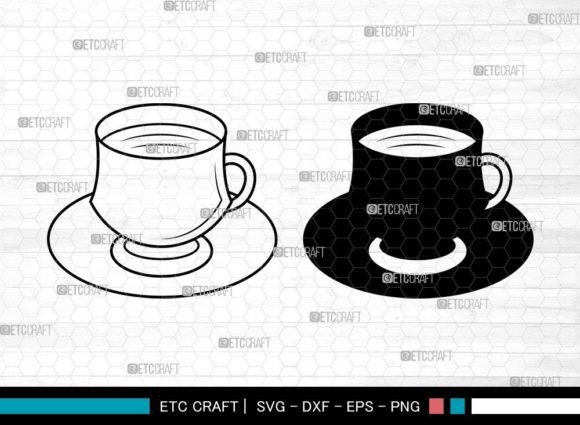
Tea Cup SVG, Cup SVG, Cup and Saucer
A Designer’s First Glance: Charm Without Clutter
When I opened Tea Cup SVG, Cup Svg, Cup and Saucer for the first time, what stood out wasn’t just the shape—it was the quiet confidence in its simplicity. This isn’t a fussy, overly detailed illustration meant for framing; it’s a clean, balanced silhouette of a classic teacup resting on its saucer, with gentle curves and intentional negative space. It reads as warm, approachable, and timeless—perfect for a handmade apron, a nursery tea towel, or a small-batch embroidered tote bag destined for a local boutique. As a designer who evaluates hundreds of embroidery files each year, I appreciate how this one avoids visual noise. No tiny handles that vanish under satin stitch. No fragile stems that fray after two washes. Just honest, stitch-friendly form.
How It Performs on Real Embroidery Projects
I tested Tea Cup SVG, Cup Svg, Cup and Saucer across several real-world applications—and it held up best where subtlety matters most. On a lightweight cotton tea towel? Crisp, legible, and soft to the touch. On a medium-weight organic cotton sweatshirt? The outline stayed sharp without excessive fill stitch density, and the saucer’s gentle curve translated beautifully into smooth satin stitch. For baby embroidery—say, on a onesie or burp cloth—the scale worked naturally at 3.5" wide, giving enough presence without overwhelming delicate fabric.
It also shined as an embroidered patch. When stitched onto twill with tear-away stabilizer, the cup’s rim and saucer edge retained definition, and the open interior left room for creative thread choices—soft sage green for a spring collection, deep navy for a holiday line. As a machine embroidery design, it doesn’t demand heavy digitizing adjustments. That’s rare for a seemingly simple graphic. Most “cup” designs either oversimplify into blobs or overcomplicate with unnecessary interior lines. This one strikes the balance.
Where to Use It Thoughtfully
That said, Tea Cup SVG, Cup Svg, Cup and Saucer isn’t universally forgiving—and that’s okay. On stretchy knit fabric (like a fitted t-shirt), I recommend using cutaway stabilizer and reducing stitch speed. The curved base can shift slightly if tension isn’t dialed in. On dark fabric, avoid light pastel threads unless you’re adding a backing layer—some areas (like the inner cup curve) rely on contrast to read clearly. And while it scales down well to ~2.75", I wouldn’t go smaller for apparel: fine details like the subtle saucer rim begin to blur under dense fill stitch at sub-2" sizes.
It’s also not ideal for highly textured surfaces—think bouclé knits or heavily woven burlap—without extra stabilizing layers. And on curved surfaces like caps, test placement carefully: the saucer’s flat plane can distort if hooped too aggressively. As a digital embroidery file, it’s versatile—but don’t assume automatic compatibility with every machine or software. Always verify your embroidery software opens the included SVG, DXF, EPS, and PNG files cleanly before committing to a client project.
What It Adds to Your Handmade Product—and Your Reputation
This isn’t just another clipart cup. When stitched thoughtfully, Tea Cup SVG, Cup Svg, Cup and Saucer elevates the perceived value of your finished product. A customer buying a personalized embroidered pillow cover with this design doesn’t just see “tea”—they feel intention, craft, and care. That translates directly to trust, repeat orders, and word-of-mouth referrals. For Etsy sellers and small shop owners, it supports cohesive branding: pair it with hand-lettered “Steep & Smile” text or use it consistently across kitchen towels, aprons, and gift tags. It reads as professional, not generic.
And because it’s rooted in classic iconography—not trendy illustration—it stays relevant across seasons. You won’t need to retire it after one holiday launch. That longevity matters when building a library of reliable design assets for your craft business.
Practical Notes Every Embroidery Designer Should Keep Handy
- Always test first: Stitch Tea Cup SVG, Cup Svg, Cup and Saucer on scrap fabric matching your final project’s weight and texture.
- Check thread color contrast: Try it in black-on-cream and white-on-navy mockups before finalizing.
- Review stitch density: If your embroidery software allows, inspect fill stitch spacing—avoid overcrowding in the cup’s interior.
- Confirm hoop size: At standard 4"x4", it fits comfortably centered—but double-check your layout if combining with text or borders.
- Inspect small details: Zoom in on the handle attachment point and saucer edge in your editing software to ensure no stray nodes or overlapping paths.
- Use proper stabilizer: Medium-weight cutaway for knits, tear-away for stable wovens, and fusible + tear-away for lightweight linens.
- Licensing check: Since this is listed as a Graphics product in the Crafts category, confirm whether commercial use (e.g., selling finished embroidered items or digital bundles) is permitted before scaling for your shop.
Final Thought: A Quiet Workhorse, Not a Flashy Gimmick
In a market flooded with overdesigned, overpromised embroidery files, Tea Cup SVG, Cup Svg, Cup and Saucer stands out by doing less—and doing it well. It’s the kind of embroidery file I reach for when I need reliability over novelty: for a wedding gift set of monogrammed napkins, a small-batch run of café-branded aprons, or a limited holiday collection of embroidered tea towels. It doesn’t shout. It invites. And in handmade goods, that kind of quiet confidence is exactly what builds lasting connection—with fabric, with customers, and with craft.